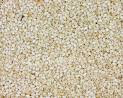
Sesame seeds Sesame seeds add a nutty taste and a delicate, almost invisible, crunch to many Asian dishes. They are also the main ingredients in tahini (sesame seed paste) and the wonderful Middle Eastern sweet call halvah. They are available throughout the year.
Sesame seeds may be the oldest condiment known to man dating back to as early as 1600 BC. They are highly valued for their oil which is exceptionally resistant to rancidity. "Open sesame," the famous phrase from the Arabian Nights, reflects the distinguishing feature of the sesame seed pod, which bursts open when it reaches maturity. The scientific name for sesame seeds is Sesamun indicum.

This chart graphically details the %DV that a serving of Sesame seeds provides for each of the nutrients of which it is a good, very good, or excellent source according to our Food Rating System. Additional information about the amount of these nutrients provided by Sesame seeds can be found in the Food Rating System Chart. A link that takes you to the In-Depth Nutritional Profile for Sesame seeds, featuring information over 80 nutrients, can be found under the Food Rating System Chart.
Health Benefits
Not only are sesame seeds a very good source of manganese and copper, but they are also a good source of calcium, magnesium, iron, phosphorus, vitamin B1, zinc and dietary fiber. In addition to these important nutrients, sesame seeds contain two unique substances: sesamin and sesamolin. Both of these substances belong to a group of special beneficial fibers called lignans, and have been shown to have a cholesterol-lowering effect in humans, and to prevent high blood pressure and increase vitamin E supplies in animals. Sesamin has also been found to protect the liver from oxidative damage.
Rich In Beneficial Minerals
Sesame seeds are a very good source of copper and a good source of magnesium and calcium. Just a quarter-cup of sesame seeds supplies 74.0% of the daily value for copper, 31.6% of the DV for magnesium, and 35.1% of the DV for calcium. This rich assortment of minerals translates into the following health benefits:
Copper Provides Relief for Rheumatoid Arthritis
Copper is known for its use in reducing some of the pain and swelling of rheumatoid arthritis. Copper's effectiveness is due to the fact that this trace mineral is important in a number of antiinflammatory and antioxidant enzyme systems. In addition, copper plays an important role in the activity of lysyl oxidase, an enzyme needed for the cross-linking of collagen and elastin--the ground substances that provide structure, strength and elasticity in blood vessels, bones and joints.
Magnesium Supports Vascular and Respiratory Health
Studies have supported magnesium's usefulness in:
- Preventing the airway spasm in asthma
- Lowering high blood pressure, a contributing factor in heart attack, stroke, and diabetic heart disease
- Preventing the trigeminal blood vessel spasm that triggers migraine attacks
- Restoring normal sleep patterns in women who are experiencing unpleasant symptoms associated with menopause
Calcium Helps Prevent Colon Cancer, Osteoporosis, Migraine and PMS
In recent studies, calcium has been shown to:
- Help protect colon cells from cancer-causing chemicals
- Help prevent the bone loss that can occur as a result of menopause or certain conditions such as rheumatoid arthritis
- Help prevent migraine headaches in those who suffer from them
- Reduce PMS symptoms during the luteal phase (the second half) of the menstrual cycle
There is a little bit of controversy about sesame seeds and calcium, because there is a substantial difference between the calcium content of hulled versus unhulled sesame seeds. When the hulls remain on the seeds, one tablespoon of sesame seeds will contains about 88 milligrams of calcium. When the hulls are removed, this same tablespoon will contain about 37 milligrams (about 60% less). Tahini-a spreadable paste made from ground sesame seeds-is usually made from hulled seeds (seeds with the hulls removed, called kernels), and so it will usually contain this lower amount of calcium.
The term "sesame butter" can sometimes refer to tahini made from sesame seed kernels, or it can also be used to mean a seed paste made from whole sesame seeds-hull included.
Although the seed hulls provide an additional 51 milligrams of calcium per tablespoon of seeds, the calcium found in the hulls appears in large part to be found in the form of calcium oxalate. This form of calcium is different than the form found in the kernels, and it is a less absorbable form of calcium. So even though a person would be likely to get more calcium from sesame seeds or sesame seed butter that contained the hulls, there is a question about how much more calcium would be involved. It would defintely be less than the 51 additional milligrams found in the seed hulls. And there would also, of course, be a question about the place of hull-containing sesame seeds on an oxalate-restricted diet.
Zinc for Bone Health
Another reason for older men to make zinc-rich foods such as sesame seeds a regular part of their healthy way of eating is bone mineral density. Although osteoporosis is often thought to be a disease for which postmenopausal women are at highest risk, it is also a potential problem for older men. Almost 30% of hip fractures occur in men, and 1 in 8 men over age 50 will have an osteoporotic fracture. A study of 396 men ranging in age from 45-92 that was published in the American Journal of Clinical Nutrition found a clear correlation between low dietary intake of zinc, low blood levels of the trace mineral, and osteoporosis at the hip and spine.
Sesame Seeds' Phytosterols Lower Cholesterol
Phytosterols are compounds found in plants that have a chemical structure very similar to cholesterol, and when present in the diet in sufficient amounts, are believed to reduce blood levels of cholesterol, enhance the immune response and decrease risk of certain cancers.
Phytosterols beneficial effects are so dramatic that they have been extracted from soybean, corn, and pine tree oil and added to processed foods, such as "butter"-replacement spreads, which are then touted as cholesterol-lowering "foods." But why settle for an imitation "butter" when Mother Nature's nuts and seeds are a naturally rich source of phytosterols-and cardio-protective fiber, minerals and healthy fats as well?
In a study in the Journal of Agricultural and Food Chemistry, researchers published the amounts of phytosterols present in nuts and seeds commonly eaten in the United States.
Sesame seeds had the highest total phytosterol content (400-413 mg per 100 grams), and English walnuts and Brazil nuts the lowest (113 mg/100grams and 95 mg/100 grams). (100 grams is equivalent to 3.5 ounces.) Of the nuts and seeds typically consumed as snack foods, pistachios and sunflower seeds were richest in phytosterols (270-289 mg/100 g), followed by pumpkin seeds (265 mg/100 g).
Description
Sesame seeds are tiny, flat oval seeds with a nutty taste and a delicate, almost invisible crunch. They come in a host of different colors, depending upon the variety, including white, yellow, black and red.
Sesame seeds are highly valued for their high content of sesame oil, an oil that is very resistant to rancidity. Sesame seeds are the main ingredients in both tahini and the Middle Eastern sweet treat, halvah.
"Open sesame," the famous phrase from the Arabian Nights, reflects the distinguishing feature of the sesame seed pod, which bursts open when it reaches maturity. The scientific name for sesame seeds is Sesamun indicum.
History
While sesame seeds have been grown in tropical regions throughout the world since prehistoric times, traditional myths hold that their origins go back even further. According to Assyrian legend, when the gods met to create the world, they drank wine made from sesame seeds.
These seeds were thought to have first originated in India and were mentioned in early Hindu legends. In these legends, tales are told in which sesame seeds represent a symbol of immortality. From India, sesame seeds were introduced throughout the Middle East, Africa and Asia.
Sesame seeds were one of the first crops processed for oil as well as one of the earliest condiments. The addition of sesame seeds to baked goods can be traced back to ancient Egyptian times from an ancient tomb painting that depicts a baker adding the seeds to bread dough.
Sesame seeds were brought to the United States from Africa during the late 17th century. Currently, the largest commercial producers of sesame seeds include India, China and Mexico.
How to Select and Store
Sesame seeds are generally available in prepackaged containers as well as bulk bins. Just as with any other food that you can purchase in the bulk section, make sure that the bins containing the sesame seeds are covered and that the store has a good product turnover to ensure maximal freshness.
Whether purchasing sesame seeds in bulk or in a packaged container, make sure there is no evidence of moisture. Additionally, since they have a high oil content and can become rancid, smell those in bulk bins to ensure that they smell fresh.
Unhulled sesame seeds can be stored in an airtight container in a cool, dry, dark place. Once the seeds are hulled, they are more prone to rancidity, so they should then be stored in the refrigerator or freezer.
How to Enjoy
A Few Quick Serving Ideas:
Add sesame seeds into the batter the next time you make homemade bread, muffins or cookies.
Use the traditional macrobiotic seasoning, gomasio, to enliven your food. You can either purchase gomasio at a health food store or make your own by using a mortar and pestle. Simply mix together one part dry roasted sea salt with twelve parts dry roasted sesame seeds.
Sesame seeds add a great touch to steamed broccoli that has been sprinkled with lemon juice.
Spread tahini (sesame paste) on toasted bread and either drizzle with honey for a sweet treat or combine with miso for a savory snack.
Combine toasted sesame seeds with rice vinegar, tamari and crushed garlic and use as a dressing for salads, vegetables and noodles.
Healthy sauté chicken with sesame seeds, tamari, garlic, ginger and your favorite vegetables for a healthy, but quick, Asian-inspired dinner.
Safety
Sesame seeds are not a commonly allergenic food and are not known to contain measurable amounts of goitrogen or purines. However, the hulls of sesame seeds do contain oxalates. In fact, most of the calcium found in the seed hull comes in the form of calcium oxalate. The sesame seed paste (tahini) found in grocery stores is most often made with seed kernels-the part of the sesame seed that remains after the hull has been removed. These products would generally be safe in moderate amounts on an oxalate-restricted diet. However, products containing the seed hulls might have more oxalates than desired on a low oxalate meal plan. Product labels do not always indicate whether the hulls have been removed or not. For this reason, check the color of the tahini carefully and also inquire as to its taste. Most sesame seed butters made from whole, non-hulled seeds are fairly dark in color and have a much more bitter taste than butters made from hulled sesame kernels. For more on the subject of oxalates, please see
"Can you tell me what oxalates are and in which foods they can be found?" Nutritional Profile
Sesame seeds are a very good source of the minerals copper and manganese. They are also a good source of magnesium, calcium, iron, phosphorus, vitamin B1 and zinc. In addition, sesame seeds are a good source of both dietary fiber and monounsaturated fats.
For an in-depth nutritional profile click here: Sesame seeds.
In-Depth Nutritional Profile
In addition to the nutrients highlighted in our ratings chart, an in-depth nutritional profile for
Sesame seeds is also available. This profile includes information on a full array of nutrients, including carbohydrates, sugar, soluble and insoluble fiber, sodium, vitamins, minerals, fatty acids, amino acids and more.
Introduction to Food Rating System Chart
In order to better help you identify foods that feature a high concentration of nutrients for the calories they contain, we created a Food Rating System. This system allows us to highlight the foods that are especially rich in particular nutrients. The following chart shows the nutrients for which this food is either an excellent, very good, or good source (below the chart you will find a table that explains these qualifications). If a nutrient is not listed in the chart, it does not necessarily mean that the food doesn't contain it. It simply means that the nutrient is not provided in a sufficient amount or concentration to meet our rating criteria. (To view this food's in-depth nutritional profile that includes values for dozens of nutrients - not just the ones rated as excellent, very good, or good - please use the link below the chart.) To read this chart accurately, you'll need to glance up in the top left corner where you will find the name of the food and the serving size we used to calculate the food's nutrient composition. This serving size will tell you how much of the food you need to eat to obtain the amount of nutrients found in the chart. Now, returning to the chart itself, you can look next to the nutrient name in order to find the nutrient amount it offers, the percent Daily Value (DV%) that this amount represents, the nutrient density that we calculated for this food and nutrient, and the rating we established in our rating system. For most of our nutrient ratings, we adopted the government standards for food labeling that are found in the U.S. Food and Drug Administration's "Reference Values for Nutrition Labeling."
Read more background information and details of our rating system.
Sesame seeds
0.25 cup
36.00 grams
206.28 calories | | Nutrient | Amount | DV
(%) | Nutrient
Density | World's Healthiest
Foods Rating | | copper | 1.48 mg | 74.0 | 6.5 | very good | | manganese | 0.88 mg | 44.0 | 3.8 | very good | | tryptophan | 0.12 g | 37.5 | 3.3 | good | | calcium | 351.00 mg | 35.1 | 3.1 | good | | magnesium | 126.36 mg | 31.6 | 2.8 | good | | iron | 5.24 mg | 29.1 | 2.5 | good | | phosphorus | 226.44 mg | 22.6 | 2.0 | good | | zinc | 2.80 mg | 18.7 | 1.6 | good | | vitamin B1 (thiamin) | 0.28 mg | 18.7 | 1.6 | good | | dietary fiber | 4.24 g | 17.0 | 1.5 | good | World's Healthiest
Foods Rating | Rule | | excellent | DV>=75% | OR | Density>=7.6 | AND | DV>=10% | | very good | DV>=50% | OR | Density>=3.4 | AND | DV>=5% | | good | DV>=25% | OR | Density>=1.5 | AND | DV>=2.5% | |
In-Depth Nutritional Profile for Sesame seeds
 In a study entitled The Effect of Sour Tea (Hibiscus sabdariffa) on Essential Hypertension, the authors point out that "a heaping tablespoon of the dried hibiscus tea steeped in a quart of boiling water is sufficient to achieve this blood-pressure lowering effect (2-3 tea bags of hibiscus tea). Details of the study were summed up in the Journal of Ethnopharmacology, Volume 65, Issue 3, pp. 231 - 236, June, 1999.
  In yet another instance, scientists in Taiwan reported in The Journal of the Science of Food Agriculture that hibiscus tea made from the hibiscus flower (Hibiscus sabdariffa) may help control cholesterol, and thereby reduce the risk of heart disease. Scientists stated that the extract from the hibiscus flower significantly lowered the cholesterol content in the blood serum of lab animals, and successfully prevented oxidation of low-density lipoprotein. The extract has also been used in folk medicine to treat high blood pressure and liver disorder.